Ambitious new All-Ireland Pollinator Plan aims to create ‘pockets for nature every 200 metres’
A new five-year plan brings together communities, farmers, businesses, and public bodies to create a more biodiversity-rich landscape.
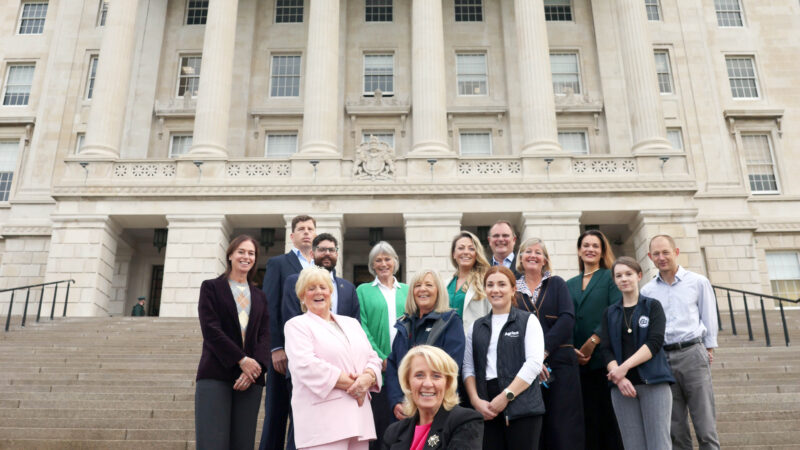
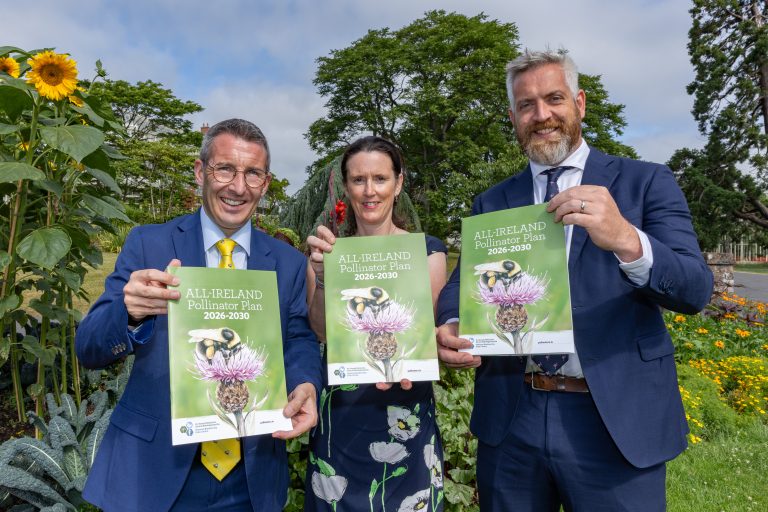
The new All-Ireland Pollinator Plan 2026-2030 was launched today [9 July] at the National Botanic Gardens, Dublin, by Andrew Muir MLA, Minister for the Department of Agriculture, Environment and Rural Affairs (DAERA), and Christopher O’Sullivan, Ireland’s Minister of State at the Department of Housing, Local Government and Heritage.
The All-Ireland Pollinator Plan is a voluntary framework coordinated by the National Biodiversity Data Centre and supported by a wide network of partner organisations across both jurisdictions, with the Northern Ireland Environment Agency leading in Northern Ireland. This 2026-2030 phase of the Pollinator Plan is supported through funding from the Government of Ireland’s Shared Island Fund, the National Parks and Wildlife Service, the Department of Agriculture, Food and the Marine, and the Department of Agriculture, Environment and Rural Affairs (DAERA).
In his launch address, DAERA Minister, Andrew Muir said: “Bees, butterflies and our other pollinators are the unsung heroes of our environment, playing a fundamental role across our ecosystems. The All-Ireland Pollinator Plan provides a clear, practical framework to support these busy bugs in enabling nature recovery. By working together, across all landscapes, it is possible to restore pollinator populations and create an island that is richer in biodiversity, more resilient to climate change, and better for people and nature alike.”
The All-Ireland Pollinator Plan is fundamentally a collective effort. Its success depends on the voluntary participation of farmers, organisations, communities, and individuals who commit to implementing actions within their own areas of influence. They enable plant reproduction, support biodiversity, and underpin agricultural productivity and food security. However, wild pollinators, including over 100 wild bee species, are in decline due to habitat loss, climate change, and pollution (pesticide use). One-third of bee species on the island of Ireland are at risk of extinction. Therefore, addressing pollinator decline is both an ecological necessity and a societal priority.
The vision of the All-Ireland Pollinator Plan 2026–2030 is simple but ambitious: to create a landscape that provides food and shelter every 200 metres, where pollinators can survive and thrive. This mission reflects that our important solitary bees can only travel these short distances from their nest sites to find food. Achieving this vision will require coordinated action across all land types, supported by strong partnerships and public engagement.
Since its inception in 2015, the All-Ireland Pollinator Plan has become internationally renowned as best practice, and as successful model that has been copied by other European States in developing their own action plans to reverse pollinator declines. The Plan is built on robust scientific research, and all recommended actions are evidence-based.
Dr Sara McGuckin, Head of Natural Science in NIEA said: “Halting and reversing pollinator species decline is essential to securing healthy, resilient ecosystems and sustainable food systems. NIEA is delighted to continue our strong partnership through the All Ireland Pollinator Plan to 2030. By strengthening our monitoring of pollinators, we can develop a better understanding of what our rare and threatened species need and track recovery of pollinator populations across Ireland.”
In a time of climate and biodiversity anxiety, the All Ireland Pollinator Plan empowers people to create positive change for our future and provides all the knowledge and tools to allow anyone to take action for biodiversity.
Its ethos is simple: ‘small actions, taken together, can create real change – helping to restore pollinators in order to build a healthier, more resilient environment for everyone.’